
Google’s New AI Content Guidelines: A Manual Verification Checklist for Marketing Teams
Artificial intelligence has transformed the way marketing teams produce digital content. It can do everything from writing blog posts and product descriptions to developing marketing campaigns, and it drafts polished pieces in a fraction of the time it would take a human to complete the same task. However, speed and convenience do not always guarantee accuracy, originality, or quality, and Google’s new manual checking guidance for AI content shows just how important a human review of content will be moving forward.
In this article, we explore why manual checking is a non-negotiable for marketers utilizing AI copy and how teams can create a smooth workflow to optimize their content production process.
What Is the Manual Checking Guidance for AI Content in Google?
On October 1, 2026, Google updated its Search Central guidance to say it’s critical for publishers to manually fact-check and review all AI-generated content before publishing. Since search engines want to make sure users are receiving the best answers to their queries at all times, this guidance acts as a type of quality control to ensure responses are accurate.
Google’s update also makes it clear that manual checking extends beyond the main body of an article. Your marketing team should also be making sure your page titles, meta descriptions, structured data, and image alt text are trustworthy before they appear in Google SERPs.
While this might feel like a penalty for businesses, that’s not the case. Google is simply prioritizing users’ search experience and added this AI content verification recommendation to ensure visitors are receiving the best information possible to satisfy their queries.
Why Is Manual Checking Important for AI-Generated Content?
1. Ensures Factual Accuracy
Large Language Models (LLMs) sometimes hallucinate and create information that isn’t completely accurate, and this isn’t just a problem for the search engine that brought the user to your site. When this unverified content is published, it erodes trust with your website visitor, and it signals to Google that you’re not a strong authority on the topic.
2. Improves Content Quality and Readability
AI-generated text sounds good, but it doesn’t always sound human. There are certain prompts you can use to improve the flow of what the LLM you’re using outputs. However, only a human editor can fix unnatural cadences, repetitive sentences and overused hyperboles and metaphors to make the writing sound more natural.
3. Maintains Brand Voice and Consistency
Your business has a specific identity and brand voice, and it is very challenging for an LLM to sound like you 100% of the time. By manually reviewing AI content during the editing process, you’re more likely to have a finished product that sounds and looks on brand.
4. Supports SEO Best Practices
Even in the age of AI, good search engine optimization (SEO) can help you rank for keywords your audience is actively searching for. But sometimes, LLMs will generate content that overlooks some of these best practices. The only way to catch these errors is by performing human-led SEO content checks.
5. Helps Protect Credibility and Trust
Your customers expect you to provide reliable information. Publishing unchecked AI-generated content can damage that trust, especially when articles contain misleading claims, incorrect recommendations, or fabricated references. By manually reviewing content before you publish, you can correct any misleading or incorrect statements before they go live.
What Should You Check When Reviewing AI Content Manually?
When you’re conducting your human review of AI content, there are a few things you should be checking for. This includes:
- Brand, legal and compliance requirements
- Factual accuracy and source verification
- Tone and alignment with brand voice
- Keyword placing and search intent
- Grammar, spelling and readability
- Content originality
A Manual AI Content Verification Checklist for Marketing Teams
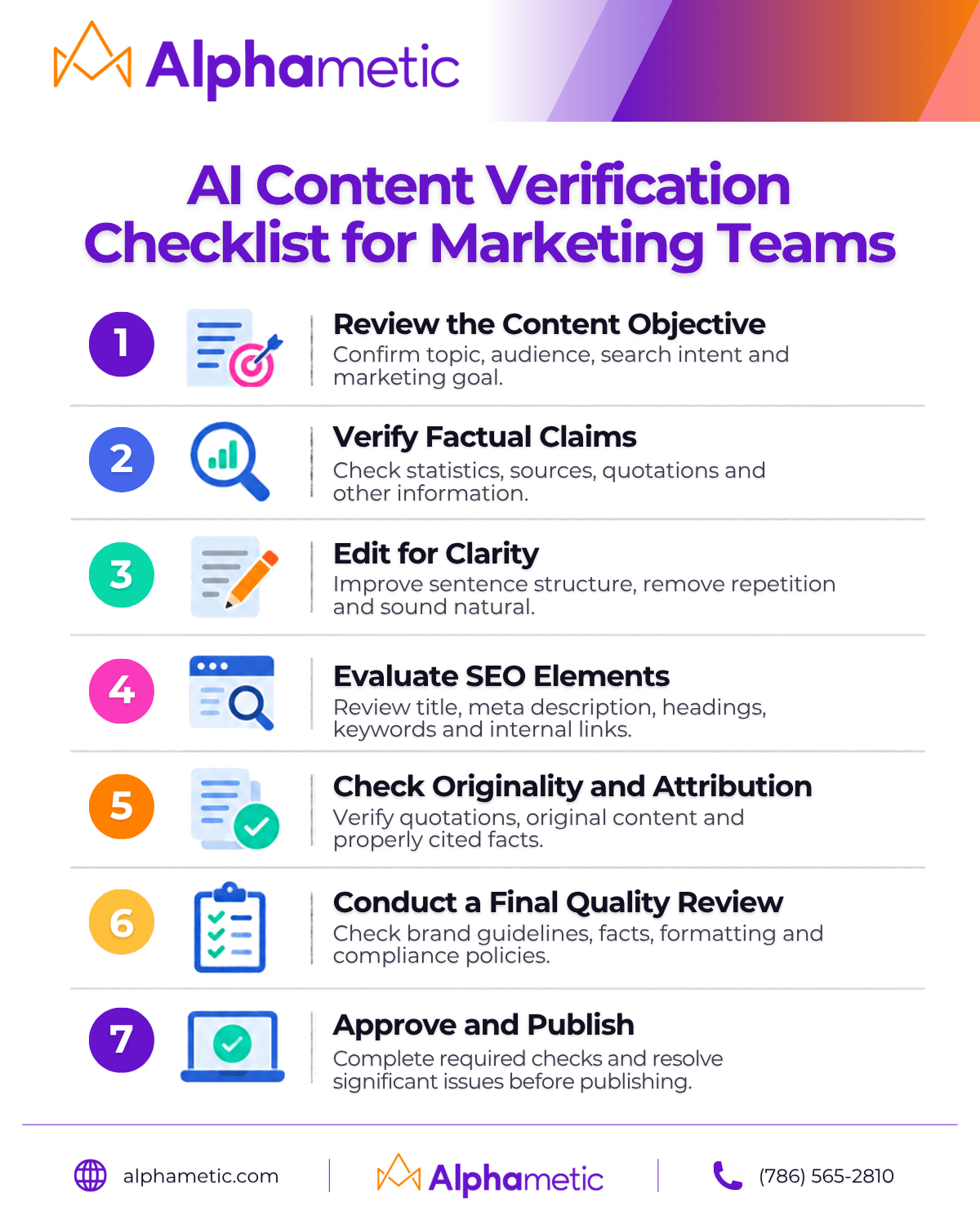
One of the easiest ways to simplify your AI content verification process is to have a simple process you can replicate for each type of content you produce. Here’s a straightforward strategy you can use to make your process as easy as possible.
Step 1: Review the content objective. Confirm your draft matches the intended topic, target audience, search intent and marketing goal.
Step 2: Verify factual claims. Check statistics, sources, quotations and other information to confirm it’s correct.
Step 3: Edit for clarity and readability. Improve sentence structure, remove repetition and make your content sound as natural as possible.
Step 4: Evaluate SEO elements. Review the title, meta description, headings, keyword usage and internal links.
Step 5: Check originality and attribution. Make sure all quotations are verifiable, the content is original and facts mentioned in your text are properly cited.
Step 6: Conduct a final quality review. Confirm your content meets brand guidelines, factual standards, formatting requirements and any relevant compliance policies.
Step 7: Approve and publish. Publish your content only after the required checks have been completed and any significant issues have been resolved.
Common Mistakes to Avoid When Checking AI Content
Even when editors review AI-generated material, several mistakes can undermine the process.
- Overusing keywords: Excessive keyword repetition can make content unnatural and reduce readability.
- Ignoring your target audience: Make sure your content is applicable to the client you’re trying to reach.
- Skipping the final review: Make sure all links, headings, formatting, and references are correct.
Avoiding these mistakes helps create more trust with your target audience and stronger signals of quality to search engines.
Conclusion
The manual checking recommendation for AI content is an important step in quality assurance for brands, and it helps ensure your content is accurate, trustworthy, and positioned to perform in search.
Combining AI-assisted writing with thoughtful human review creates a more dependable content workflow that supports efficiency without sacrificing quality.
Manual Content Checking FAQs
Is AI checking necessary for my website?
Yes. Google’s latest guidance calls manual review of AI-generated content critical, so it should be a standard part of your publishing process.
I’ve been using AI-written content on my website. Is this a problem?
No, it is not necessarily a problem if you’ve been using AI content on your website. If you’ve been using the tool correctly, Google likely will not penalize your site.
What does this manual checking guidance mean for my site?
To adhere to this new recommendation, review your previously published content to ensure it is accurate and helpful to your audience.

Matthew Capala is a seasoned digital marketing executive, founder/CEO of Alphametic, a Miami-based digital marketing agency, author of “The Psychology of a Website,” dynamic speaker, and entrepreneur.


Leave a Reply
Want to join the discussion?Feel free to contribute!